

asahi.com(朝日新聞社):Electric DeLorean back for the future - English
Trust the Japanese to take a great idea and make it better. DeLorean - one of the most iconic cars of the 80s gets a new lease of life from university teachers and students in Hiroshima. There may be a commercial proposition here - how about an electric conversion kit to breathe life into all the old cars. Instead of junking old cars and recycling only a portion of metal, you could recycle 100%. Think of all the landfills, the energy used for recycling metal, the pollution and the terrible waste that could be avoided. This whole concept of having a new car every 3-5 years is so out of line with the current focus on environment - I wish someone would take up these real recycling ideas in right earnest.
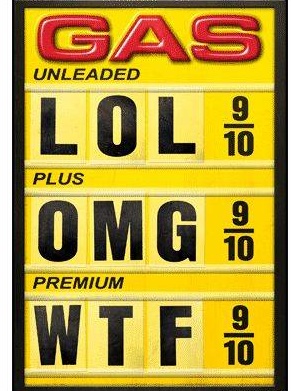
 I just noticed my blog post from last June and gas was touching almost $5. This weekend I took another picture with gas at close to $2!
How long do we have before inflation sets in? I say drive all you can - see California. I can recommend this great show - "Bay Area Backroads" for some excellent weekend driving ideas:
Here's the picture from June 2008


As store earnings plunged last week, the National Retail Federation proposed that the country create the mother of all sales by suspending taxes on all purchases. These tax holidays would occur in March, July and October and be national in scope.
The bill, they suggested, should be picked up by--who else?--the federal taxpayer, who would make up for the lost local revenues even for the five states without sales taxes. The rationale, suggests the Federation's chairman,
Now I can understand the manager at the local
In fact, if there is one thing Americans do not need, it is yet another incentive to spend money they do not have. This has become a fixture of stimulus-think under the Bernanke-Bush regime. Remember the tax rebates earlier in the year? That was a big help, wasn't it?
Sadly, this "shop 'til you go bankrupt" strategy is being adopted by the new kingpins in Washington as well. Already you can hear Barney Frank, chair of the House Financial Services Committee, talking about a big stimulus to "prop up consumption."
This quick-fix approach has become a new genus of bipartisan madness. Like "the best minds of my generation ... looking for an angry fix"--to recall Allen Ginsberg's Howl--politicians and policymakers seem to feel we need some quick high to restore our battered economy.
Like a bad drug habit, reckless stimulation may make us feel better in the short term, but it could leave us shaky later on. To be effective over time, a stimulus plan must first address some fundamental challenges that have haunted the American economy for a generation.
Of course, there are countries that should be spending more. Places like China, Germany and Japan have gotten fat off our consumption. Now their beggar-thy-neighbor policies are backfiring as shopaholic nations, most notably the U.S., rein in their spending.
In contrast, our economy's failing stems from not producing nearly enough in goods and services to pay our bills. Our long-term weakness stems not from a shortage of consumer credit--the main obsession of Wall Street and both parties--but from the decline in manufacturing, growing dependence on imported fuel and deteriorating basic infrastructure.
Our consumption patterns--coupled with disdain for production--explain how our deficit in goods-related trade alone has soared over the past two decades from roughly $100 billion annually to over $800 billion. In the process, we have created an enormous shift in currency reserves to countries like China, Russia, India, Korea, Brazil and Taiwan. They produce and save too much; we consume and borrow too much.
Reversing this dangerous disequilibrium does not necessitate the end for American-style capitalism--as suggested recently by France's president, Nicolas Sarkozy--but instead a paradigm shift within it.
First, we need to swear off our addiction to hype-driven bubbles, seen first in technology and more recently in real estate. The fact that the government may be about to start yet another--this one colored "green"--suggests bad habits are hard to break.
Of course, bubbles certainly benefit some individuals and companies, most notably the financial sectors, who can best take advantage of wild speculative swings. The financial sector's share of profits more than doubled as a percentage of national income since the 1980s.
However, this pattern has not worked so well for most Americans, who have seen their wages stagnate or even fall. Most of us would benefit far more from robust growth that stems from productive industries like energy, fiber, food, logistics and manufacturing. Parts of the industrial Midwest, Texas and the Southeast have enjoyed expansions in these fields--until the onset of the recession, at least.
More important, productive economic growth creates demography far more egalitarian than the Namibia-like bifurcation that characterizes bubble centers like Manhattan and San Francisco. In fact, notes University of Washington demographer Richard Morrill, areas with greater concentration of these kinds of industries tend to suffer less inequality and offer better prospects for the average middle class worker.
Concerns over income equality should persuade Democrats--the supposed party of the people--to focus primarily on the basics of economic growth. This is precisely what we have not been doing for over a generation.
Just think of the billions sunk into convention centers, yuppie condos, performing arts centers and other ephemera. These produce some high-wage short-term construction and architecture jobs, but after that, they offer largely low-paying service work. Meanwhile the Chinese and other competitors dredge new harbors, build high-speed rail systems, new freeways and fiber-optic lines--the keys for pushing their economies to the next stage.
Sure, you can say, the Chinese are also hurting from this financial crisis. But at least they can pay for their own stimulus. The Germans, Russians and Japanese, for now, can also dip into their dollar reserves to pay for new infrastructure investment. In contrast, we will have to beg the money for our stimulus like some busted-up small-town bookie.
More serious yet, the real problem may be whether we even want to make the changes necessary to boost our economy. Americans were once masters of both innovation and production, but we have begun to fall behind on both counts.
Indeed, our policies no longer focus on such things as manufacturing and energy production, deeming them beneath our dignity. As early as the mid-1980s, the New York Stock Exchange issued a report baldly stating that "a strong manufacturing economy is not a requisite for a prosperous economy."
At the same time, we have deluded ourselves into believing that a small number of "creative" alchemists--software engineers, hedge fund managers, urban developers--could transform code, cash and condos into limitless pots of gold. The huge winnings of these few would then allow the rest of us to spend like teenagers on a borrowed credit card, consuming everything made by the hard-working fools abroad.
By now we should know better. Americans possess no monopoly on "creativity." Our suppliers abroad are using the billions made from selling us everyday stuff to help finance future moves up the value-added scale. You can see it in every critical field from aerospace, steel and pharmaceuticals to software services, fashion design and entertainment.
Americans can meet this challenge but not by goading the family to spend more at
Joel Kotkin is a Presidential Fellow in Urban Futures at Chapman University and executive editor of www.newgeography.com. He is finishing a book on the American future and writes a weekly column for Forbes.com.
The dumbfound jolly bird
Streaking by the seashore,
With the slowly iceberg-white leaves
Flogging while the virtuous sea
On the viperish kings star-struck
Goes to burn against the sixpenny night.
Like this poem? How about writing one yourself? It's not difficult - just t try this website:
http://www.bbc.co.uk/wales/arts/sites/themes/books/dylan_thomas_rpg.shtml?
To me the computer generated poem sounds no more gibberish than some of the human-written ones - if you get enough literary critics analyzing this, they may come up with a pretty good explanation of what the poet (in this case the random poem generation program) is trying to convey :-)
THE ASAHI SHIMBUN
2008/12/29
Print
Share Article 


Isetan Mitsukoshi Holding Ltd. announced over the weekend that it will revive its custom of closing its department stores for one day once a week.
Under measures to take effect as early as April, it said it would also cut back operating hours.
The operator hopes to save some 2 billion yen a year by reducing staff and utilities costs, officials said.
Sales at Isetan and Mitsukoshi flagship stores dropped around 10 percent in the first half of December from the same period in 2007.
Currently, only New Year's Day is a fixed holiday at both Isetan and Mitsukoshi stores.
The two chains scrapped their weekly closed days in 2000. Department stores had reduced shop closing days while extending operating hours since the 1990s.(IHT/Asahi: December 29,2008)

Another giant fell this week - no I'm not talking about the financial services companies like Lehman, AIG and WaMu. At the height of the so called strong economy (fueled primarily by cheap mortgage and home equity) we had International launch this monster truck - the CXT in 2004. Recently they announced they would discontinue it. Well, gas prices have almost doubled since 2004 and house prices have halved (don't contest the figures, they may be exaggerated but not by much) - so it shouldn't come as a surprise. I'd like to know more about the people who bought these monsters - wikipedia page says Ashton Kutcher was one of them. If you know of more owners, do comment here.

Another one of "This happens only in India" phenomenon. I don't if this signifies a weakening of the property market or it's just a reflection of the enormous wealth being built up in the country.


Just a couple of observations - just a minute part of the many changes business and leisure travelers are facing today:
Southwest is giving out only one pack of peanuts instead of two that they have always handed out for as long as I can remember!
Avis is now asking for a gas pump receipt even if the fuel needle show full tank when you return the car! According to the agent who I spoke with today, it seems a lot of people who drive their rental cars for less than 75 miles do not fill up the car as the needle would hardly have moved.
Along with charging for pillows, for checked in luggage, meals, priority boarding, fuel surcharges, etc. - the list just goes on. Do you have any interesting travel stories related to gas prices?
Be sure to comment...
It was fun watching Rare Earth perform at the Beach Boardwalk on Friday - great selection of their hits plus one new song from their latest CD - which wasn't half bad. Here are some pictures.




 Posts
Posts

